Daniel Tsen曾浩允

Observatory · GMU Young Scholars

Exoplanet follow-up photometry

A planet crossing its star blocks a small fraction of the light, so it shows up as a dip in the star’s brightness. TESS flagged TOI 5147.01 as a candidate. My part was checking it from the ground.

NASA Data Science Analysis and Scholarly Research Paper Writing Young Scholars Internship, George Mason University · under Prof. Peter Plavchan, Department of Physics & Astronomy · summer 2025 · Python, Jupyter, AstroImageJ

ResultTOI 5147.01

Light curves, and the NEB checks cleared

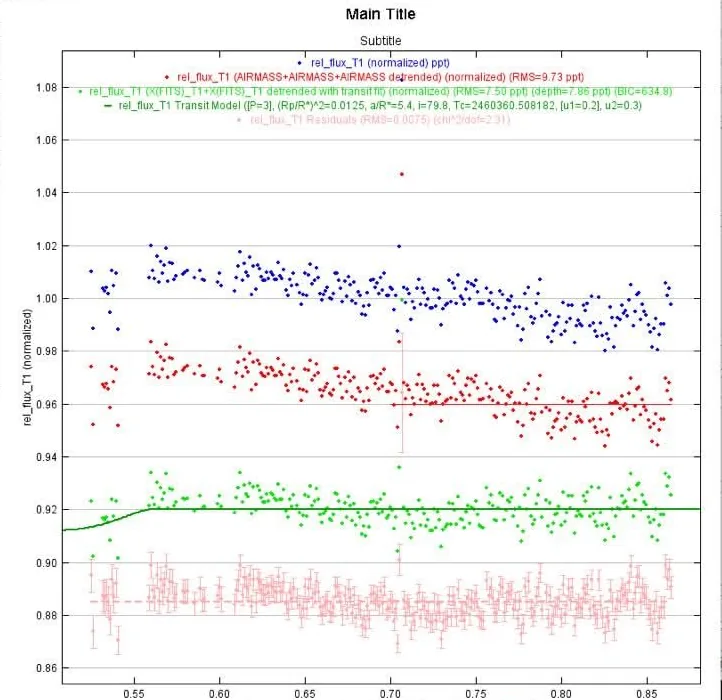
Calibrated light curves for TOI 5147.01. The nearby-eclipsing-binary checks came back clean.
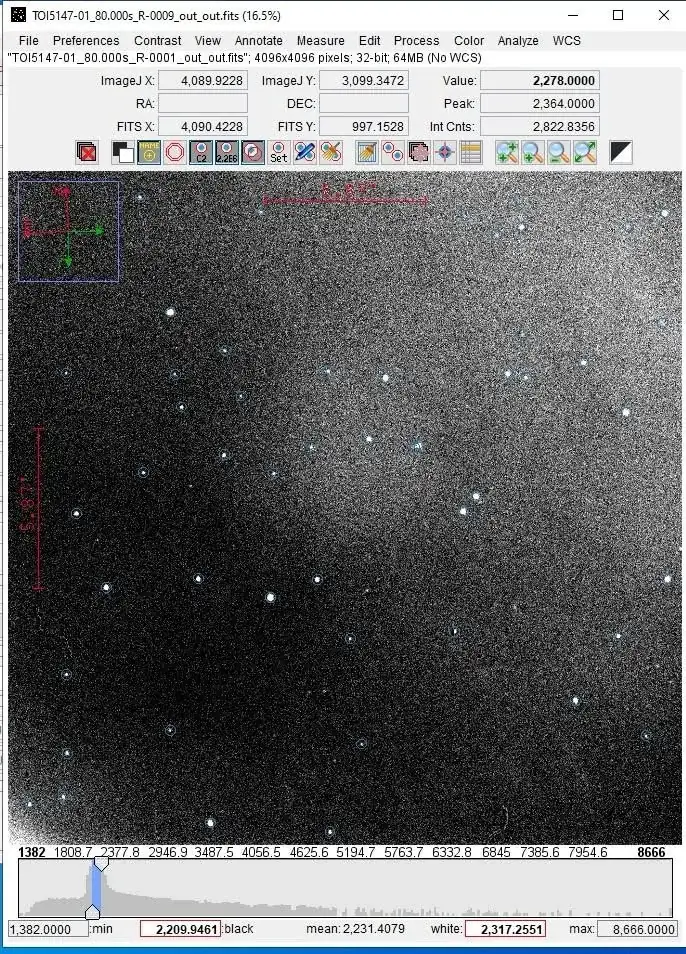
AstroImageJ window showing one 4096 by 4096 pixel FITS frame of the TOI 5147.01 star field
Fig. 1One raw frame of the TOI 5147.01 field in AstroImageJ (4096 × 4096 FITS), before calibration and plate solving.
AstroImageJ plot of the target star’s normalized relative flux over time: raw, airmass-detrended, detrended with a transit model, and residuals
Fig. 2The target star’s light curve in AstroImageJ: raw, airmass-detrended, detrended with a transit model, and residuals.
MethodFrame to light curve

What I did with the frames

  1. Scheduling through the Swarthmore transit finder, coordination through ExoFOP.

  2. Observed the TOI 5147.01 field from the ground at the GMU Observatory, then worked through the FITS frames.

  3. Plate-solved every frame: matched the detected stars against a reference catalog so each one gets its right ascension and declination.

  4. Flagged artifacts like the streaks satellites leave when they cross the field during an exposure.

  5. Calibrated with dark and flat frames.

  6. Ran multi-aperture photometry in AstroImageJ and produced calibrated light curves.

  7. Ran nearby-eclipsing-binary checks under the TFOP SG1 guidelines, with the NEB analysis macro and dmag-RMS plots.

Try itThe transit method

Transit widget

Transit, in your browserillustration · example values
depth –(Rp/R*)² –

The star uses quadratic limb darkening with example coefficients (u1 = 0.40, u2 = 0.26), so its edge is dimmer than its center. That rounds the bottom of the dip. Near the center of the star the dip is deeper than (Rp/R*)²; near the edge it is shallower. Past b = 1 − Rp/R* the transit turns grazing, and past 1 + Rp/R* it misses the star.

Off the clockMy own telescope

Still looking up

I own a Celestron StarSense Explorer LT 80AZ. I’m designing a 3D-printable equatorial mount and telescope in Fusion 360, based on the OpenAstroTech community’s work. The printing will be outsourced.
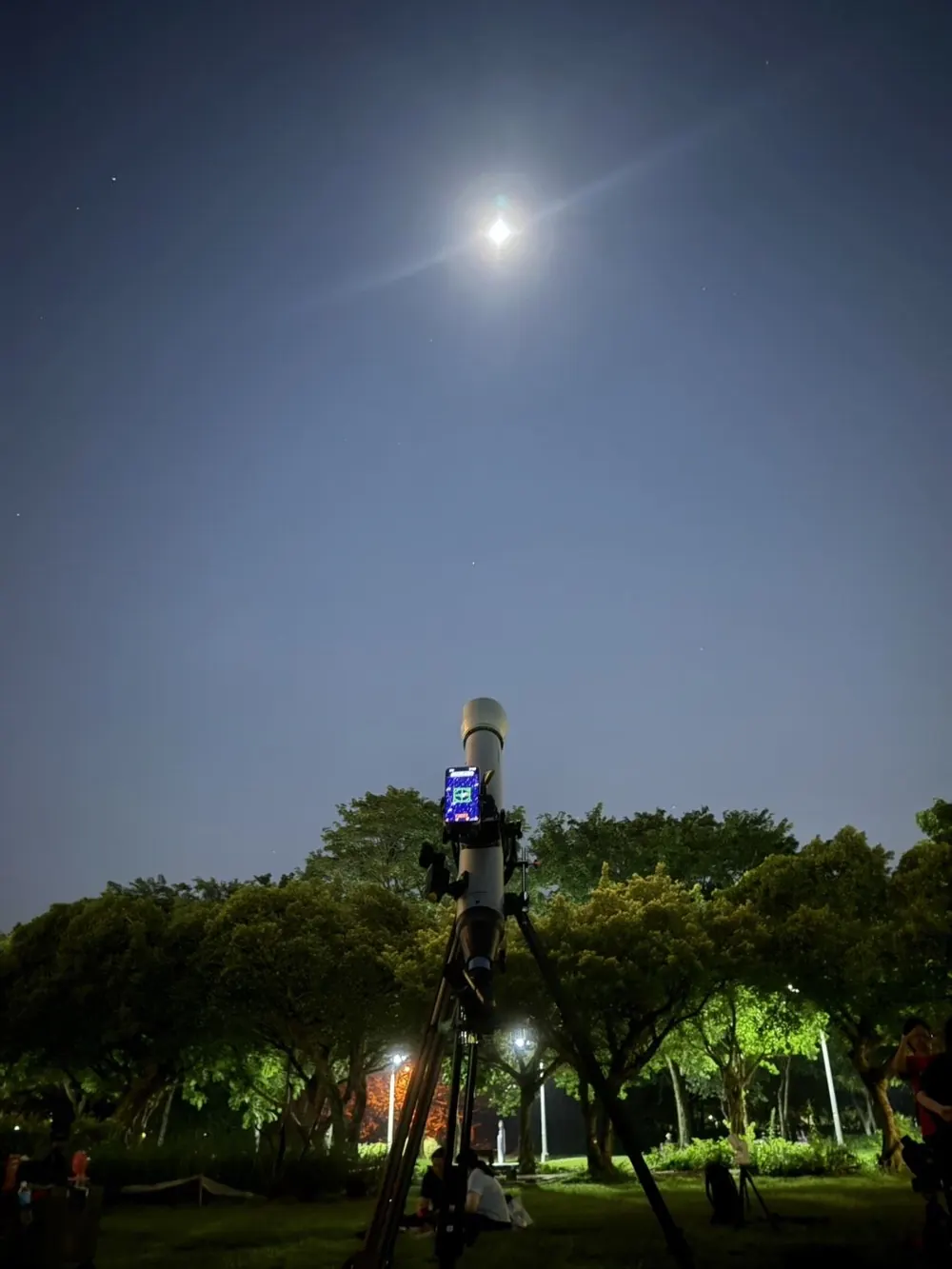
A telescope on a tripod outdoors at night under a bright moon, with trees lit from below
Fig. 3Out with the telescope at night.